
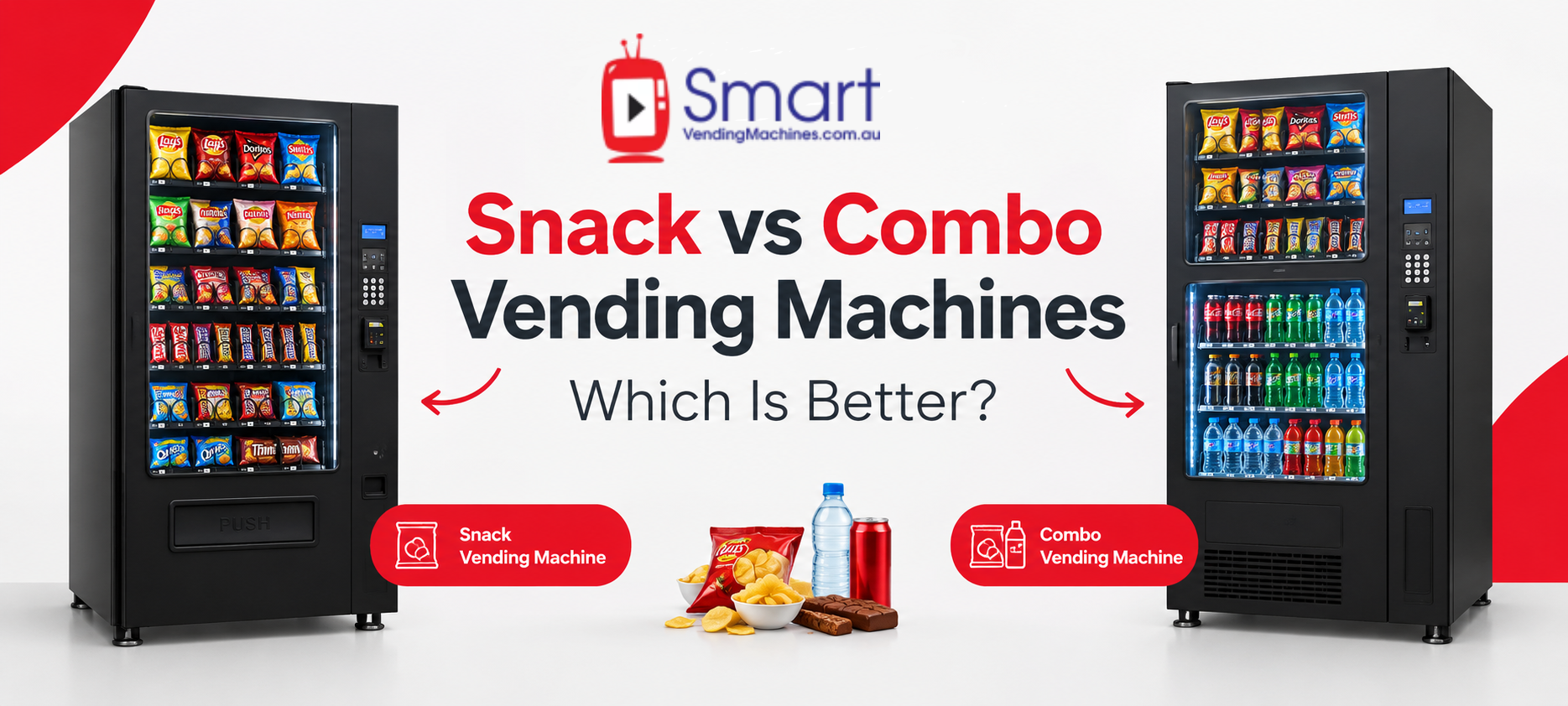
A break room stocked with the wrong machine turns lunch into a queue of frustrated staff. Office managers, gym owners and school administrators face this decision more often than they expect, and the two obvious options rarely get compared properly.
Snack vending machines cover one job well. Combination vending machines try to cover two parts of the job. Employees on a short lunch break, students between classes and gym members mid workout all want something different from a machine, and getting that choice wrong shows up fast in low usage and constant complaints.
This piece breaks down what separates the two, so the decision gets made on facts and not guesswork.
What Snack Vending Machines Do Differently
Snack vending machines hold one climate. Ambient shelving means chips, chocolate bars, biscuits and packaged food sit at room temperature, with no compressor running and no cooling unit to maintain.
That keeps the unit lighter, cheaper to run and easier to place in a corner without spare power capacity. Snack machines also fit more coil rows into the same footprint, since there’s no cooling chamber eating into the interior.
For a small office or a quiet reception area, that extra capacity means a wider range of snacks rather than a handful of duplicated products.
Snack Machine or Combo Unit at a Glance
Factor | Snack Machine | Combo Machine |
Product range | Ambient snacks only | Snacks and refrigerated drinks |
Power draw | Lower, no compressor | Higher, runs a compressor |
Interior space | More room for snack coils | Split across two zones |
Best suited to | Small offices, quiet spaces | Gyms, schools, busy break rooms |
Restocking rhythm | Slower, longer shelf life | Faster, drinks move quicker |
Foot Traffic Changes Which Machine Earns Its Keep
A small office with fifteen staff rarely justifies a combination machine. The drink compartment holds a limited number of cold cans, and low demand means stock sits past its best before date before it sells.
A busy warehouse floor or a school with three hundred students moving through at recess creates the opposite problem, where a snack only machine leaves people thirsty and walking off site to buy a drink elsewhere. Foot traffic count, not floor space, is usually the number that settles this.
When Snack Vending Machines Make More Sense
- Small teams where drink demand rarely justifies the extra power draw
- Sites with an existing drink fridge, water cooler or café nearby
- Locations with limited power capacity, since ambient units skip the compressor
- Budget conscious placements where a lower cost machine gets things started
- Areas with low foot traffic, where a fridge full of drinks would spoil before it sold
Where Combination Vending Machines Pull Ahead
- Gyms, where members want a cold drink straight after a workout
- Schools and TAFEs with long gaps between food outlets being open
- Warehouses and factories running multiple shifts
- Any site where people already leave the building to buy a drink
Combination vending machines earn their higher running costs back through convenience. One machine covering both needs means one delivery, one service visit and one point of contact, instead of juggling two suppliers or two machines competing for the same wall space.
Restocking Habits That Change Between the Two
Running costs split three ways, covering power, restocking labour and spoilage. A snack machine restocked once a fortnight rarely wastes stock, since packaged snacks carry a long shelf life.
A combo unit restocked on the same schedule risks a fridge full of drinks nobody bought in time, particularly through a slow winter. Matching the restock schedule to actual sales data avoids that waste, and remote stock monitoring on newer machines makes that adjustment straightforward instead of a guess.
Matching the Machine to the Space You Have
- Count daily foot traffic before deciding, not desk headcount
- Check available power capacity for a compressor unit
- Measure the wall space, since combo units run wider
- Ask what’s already nearby, such as a fridge, café or servo
- Factor in shift patterns if the site runs more than one shift a day
What’s Right for You?
Neither machine wins outright.
The better option depends on how many people walk past it each day and what they’re already reaching for elsewhere.
Smart Vending Machines supplies and installs both snack vending machines and combination vending machines across Australian workplaces at no upfront cost, with remote stock monitoring built in so the restocking schedule matches actual demand. Getting that first choice sorted saves months of adjusting afterwards. Inquire today!
Frequently Asked Questions
We keep an eye on this for you. A dedicated contact reviews performance and swaps out anything that's sitting unsold, so your machine keeps evolving instead of staying stuck with the wrong lineup.
Yes, our machines accept tap and go, Apple Pay, Google Pay and QR code payments. Nobody needs loose change or a wallet, which matters more than people expect once it's actually in place.
We can apply your branding to the machine itself. For workplaces that care about presentation in a lobby or break room, this turns a vending unit into something that looks intentional, not bolted on.
Yes, we work with corporate and government clients on national arrangements that update an entire fleet under one point of contact, so you're not managing separate suppliers or separate paperwork per location.
We take this seriously. Our healthy choices range includes real nutritional information at the point of sale, and we regularly trial new healthier products so the mix stays current, not decorative.
Absolutely. We build a product selection around your team, not a generic list. If your office runs on protein bars and iced coffee, that's what fills the slots, not whatever's left over.

 Address
 Phone
Phone Email
Email